
Picture that: It is mid-July in the GTA. The humidity is rising, and your backyard patio, which looked so inviting in the spring, currently feels like the surface of the sun. You want shade, and you want it now. But when you start researching solutions, you hit a wall of confusing information. Some sites list prices in US dollars, others show you the cost of just the fabric without the frame, and very few explain what it actually costs to get the thing installed on your brick wall.
It is enough to make you want to stay inside with the AC blasting.
At ROLLerUP, we believe transparency is the best policy. You deserve to know exactly what you are getting into before you start dreaming of lemonade on the deck. Pricing for awnings can be a bit of a wild west scenario online, but we are here to clear the air. Whether you are looking for a simple fixed cover or a fully automated system, understanding the awning costs in Canada 2026 is the first step toward reclaiming your outdoor space.
Key Takeaways at a Glance
- Costs Vary Widely: You can spend anywhere from $500 on a DIY fixed awning to over $8,000 on a high-end, motorized system with smart sensors.
- Installation Matters: Never overlook the cost of professional installation. Securing a heavy awning to a Canadian home requires expertise and often adds $500 to $1,500 to the project.
- Motorization is the Trend: While manual cranks save money upfront, motorized solutions are becoming the standard for ease of use and longevity.
- Canadian Climate: Our weather demands higher durability. Investing in quality fabric and wind sensors saves money on repairs later.
The Quick Answer — Average Awning Costs in Canada (2026)
If you are just looking for the numbers to set a rough budget, we have you covered. Keep in mind that these are estimated ranges for the Canadian market in 2026. They include the unit and typical professional installation fees (unless noted as DIY).
| Awning Type | Estimated Cost Range (CAD) | Best For |
| Fixed Awning (Window/Door) | $500 – $2,500+ | Small windows, permanent shade, entryways. |
| Manual Retractable Awning | $1,200 – $4,500 | Standard patios, budget-conscious homeowners. |
| Motorized Retractable Awning | $3,000 – $8,500+ | Large decks, frequent use, smart home integration. |
Why is the gap between the low and high ends so wide? It comes down to customization. A stock size from a big-box store will always be cheaper than a custom-built solution designed to fit your specific architecture. However, as the old saying goes, you get what you pay for.
Types of Awnings Explained
Before we dive deeper into the dollars and cents, let us clarify what we are actually talking about. Not all shade is created equal.
Fixed awnings
These are the stoic soldiers of the awning world. Once they are up, they are staying put. A fixed awning consists of a frame (usually aluminum or steel) with fabric stretched tightly over it. They are permanently mounted to your wall. Because they have no moving parts, they are generally durable, but they do not let in the sun on a gloomy day. Also, if you have a storm coming, they can act like a sail.
Retractable awnings (manual)
This is likely what you picture when you think of a patio awning. These units are mounted to your wall or roofline and can extend out to provide shade or retract back against the house when not in use. The “manual” part means you are the motor. You use a hand crank to open and close the system. It is a great balance of cost and function, provided you do not mind a little bit of an arm workout. Manual crank-operated awnings are easy to operate but it takes about 14 crank turns to make 1 full rotation of the fabric.
Motorized retractable awnings
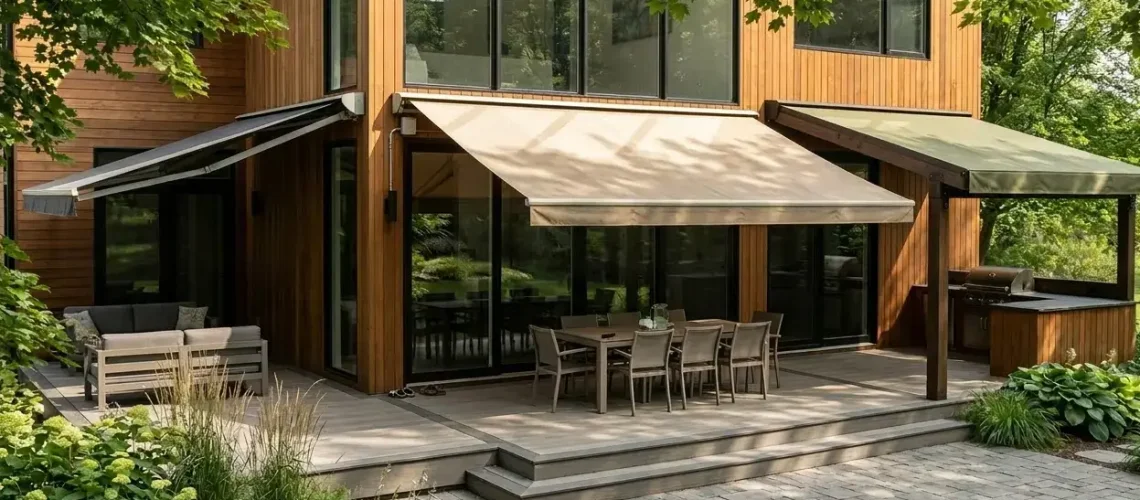
Now we are talking about luxury and convenience. Motorized awning solutions take the retractable concept and add an electric motor. You operate them via a wall switch, a handheld remote, or even a smartphone app. These systems often include advanced features such as wind, rain or sun sensors, making them the most user-friendly option for large spaces.
Awning Cost Breakdown by Type (Canada 2026)
Let’s remove the layers of the onion here. When you see a price tag, what does it actually include?
Fixed awning costs
For a standard door or window canopy, prices are relatively accessible.
- Product-Only Cost: You can find small, off-the-shelf fixed awnings for $250 to $800. Custom commercial-style fixed awnings for patios can run much higher, into the $2,000 range.
- Installed Cost: Installation for these is usually straightforward but requires a sturdy ladder and the right anchors. Expect to pay a pro $300 to $800, depending on the height and surface.
- The Bottom Line: A beautiful, custom fixed awning for a large bay window might run you about $1,500 installed.
Manual retractable awning costs
This is a popular category for retractable awning cost Canada searches because it fits many mid-range budgets.
- Product-Only Cost: A decent quality manual unit (say, 12 feet wide) might cost between $1,000 and $2,500, depending on the projection and if they want it hooded or not hooded.
- Installed Cost: Because the tension arms are under high pressure, safe installation is critical. Professional mounting usually adds $500 to $1,000.
- The Bottom Line: For a high-quality manual awning that covers a standard dining deck, budget around $2,500 to $3,500 fully installed.
Motorized retractable awning costs
When you look at a motorized awning cost, you are paying for the engineering.
- Product-Only Cost: The motor (often from brands like Somfy), the heavier-duty arms required to support the motion, and the electronics push the unit price to $2,500-$6,000, depending on size.
- Installed Cost: You have the standard mounting fee plus the electrical component. If you need an electric awning with a remote programmed and wired, expect installation to cost between $800 and $1,500.
- The Bottom Line: For a fully automated, 16-foot luxury experience with weather sensors, a realistic budget sits between $6,500 and $8500.
Also Read: Why Install Fixed Awnings for Restaurants
What Factors Affect Awning Cost the Most?
You might be wondering why your neighbour paid $3,000 while your quote came in at $5,000. There are several variables that move the needle.
Size (width and projection)
It seems obvious, but it is the biggest factor. A unit that projects 10 feet out requires significantly stronger arms and more fabric than one that projects 8 feet. The wider the awning, the more support brackets and roller tube strength are required.
Installation complexity (height, surface)
Installing into solid wood studs is one thing; installing into older brick, stucco, or siding is another. If your installer needs to use special chemical anchors, spacers to bridge a soffit, or roof-mount brackets because you lack wall space, the patio awning installation cost will rise.
Fabric quality and UV protection
Are you buying a generic polyester that will fade in two years? Or are you investing in solution-dyed acrylic fabrics (like Sunbrella) that resist fading, mould, and rot for a decade? High-quality fabric-grade material costs more upfront but saves you the cost of recovering the frame in a few seasons.
Cassette style (open vs semi vs full)
This is a detail many buyers miss.
- Open: You can see the fabric roll when the awning is closed. Cheapest option, but the fabric is exposed to rain and snow, small animals, insect nesting and sun exposure
- Semi-Cassette: Covers the top and front bottom exposed
- Full Cassette: The awning completely disappears into the housing when closed. This is the most expensive option but offers the best protection for the unit, which is important for Canadian winters. When closed, the fabric and all the components are protected from the elements at all times from elements. Other awnings require covers when not in use to provide the same protection.
Automation and smart features
Adding a wind sensor (which automatically closes the awning when it gets too breezy) or a sun sensor (which opens it when it gets too hot) adds to the cost but protects your investment.
Custom colours and finishes
Standard white frames are cheaper. If you want a custom black or bronze powder coat to match your window trim, that is a premium add-on. ROLLerUP offers multiple colours to give you beautiful choices.
Retractable vs Fixed vs Motorized — Which Is Best for You?
Still on the fence? Let’s break this down by scenario.
Best option for tight budgets
If the bank account is tight, a fixed awning over the key windows helps reduce your AC bill without breaking the bank. If you need patio shade, a standard-size manual retractable from a big-box retailer is the entry-level choice, though durability may be lower. However, you can’t control the amount the light or shade you want
Best option for patios and decks
A retractable awning is the undisputed king here. You do not want permanent poles blocking your view or flow. The ability to retract the unit means you can still stargaze at night.
Best option for large openings
If you have those beautiful sliding glass walls or a massive deck, you need a motorized retractable awning. Manually cranking a unit that is 20 feet wide is not just annoying; it is physically difficult. The motor ensures smooth, even operation every time. While cranking manually is not physically difficult, it will take a long time to retract the awning, which can be a problem if you get surprised by high winds or forget to close it.
Best option for windy locations
If you live in a wind tunnel, be careful. A fixed awning is sturdiest, but even those have limits. For a retractable option in a windy spot, a motorized unit with a wind sensor is non-negotiable. It acts as an insurance policy, closing the awning automatically when gusts pick up so the arms don’t snap.
Best option for daily use
If you plan to use this thing every day in the summer, go motorized. Human nature is funny; if you have to manually crank it, you will often just “deal with the sun” because you are feeling lazy. If it is on a remote, you will actually use it.
Installation Costs & Hidden Expenses to Plan For
We want you to have the full picture, so let’s talk about the costs that often surprise homeowners.
- Electrical Work: An electric awning with a remote needs power. If you do not have an outdoor outlet exactly where the motor is, you will need a licensed electrician to run a line. This can cost anywhere from $200 to $500+.
- Permits: In some municipalities or condo associations, you might need a permit or approval to change the exterior appearance of your home. Always check this first to avoid fines.
- Structural Reinforcement: If your house is older or has vinyl siding over foam insulation, we cannot just screw the awning in. We need to install structural headers or backing boards to prevent the heavy awning from ripping your siding off.
- Maintenance: While low, it still incurs long-term costs. Cleaning the fabric every few years are part of ownership.
Are Motorized Awnings Worth the Extra Cost?
We get asked this constantly. Is it really worth spending the extra thousand dollars (or more) for a motor?
In our professional opinion: Yes, absolutely.
Think about your TV. You could get up and change the channel manually, but would you buy a TV without a remote today? A smart awning integrates into your life. You can schedule it to open before you get home from work so the patio is cool when you arrive. With a manual awning is easy to forget to close it, so when wind rushes in without a warning, it can damage it
Furthermore, the motor creates a gentle, consistent tension that manual cranking often lacks. Manual cranking can be jerky, which puts uneven stress on the gears and arms. A motorized system creates a smooth glissade, prolonging the mechanism’s life.
Where Canadians Buy Awnings (and How That Affects Price)
Not all awning price Canada searches lead to the same quality of product.
- Big-Box Retail: You will see lower prices here. These are usually mass-produced in standard sizes. They serve a purpose, but parts can be hard to find if something breaks, the fabric and the awning frame is often lower grade.
- Online Direct-to-Consumer: These fall in the middle. You have to install it yourself (which voids many warranties if done incorrectly).
- Custom Supply & Install (Like ROLLerUP): This is the premium route. You get a cassette awning measured to the inch, fabric that matches your outdoor cushions, and an installation guarantee. The upfront cost is higher, but the lifespan of the product is typically double that of a retail unit. High-end fabric and powder-coated aluminum ensures that the awning will last you for a long time while looking fresh.
Also Read: What Are the Benefits of Motorized Retractable Screens?
2026 Awning Buying Checklist
Ready to take the next step? Use this checklist to ensure you are prepared.
- Determine Your Goal: Is it heat reduction inside the house, or shade for the patio?
- Measure Rough Dimensions: Get the width of the wall and how far out (projection) you want the shade to go.
- Check Your Mounting Surface: Is it brick, siding, stucco, or wood? This changes the hardware needed.
- Decide on Operation: Do you want to crank it, or push a button?
- Look for Power: If you want motorized, is there an outlet nearby?
- Budget Realistically: Use the ranges in this guide to set a comfortable budget.
- Compare Quotes: Look for retractable awning installation experts who detail exactly what is included.
Frequently Asked Questions
How much does a retractable awning cost in Canada, installed?
For a high-quality, mid-sized manual retractable awning installed by professionals, you should plan a budget of $2,500 to $3,500. Motorized versions will start closer to $4,500 installed.
What’s cheaper: fixed or retractable awnings?
Generally, small fixed awnings are cheaper. However, covering a large patio with a permanent fixed roof structure is usually much more expensive (and requires more permits) than a large retractable awning.
How much more does motorization add?
Adding a motor, remote, and the necessary sensors typically adds $800 to $1,500 to the price of the awning unit, depending on the motor brand.
Do motorized awnings need an electrician?
Usually, yes. Unless you have a pre-existing outdoor outlet in the exact right spot for a plug-in model, you will need hardwiring done by a pro.
What size awning do I need for a patio?
Ideally, you want the awning to cover your dining or seating area with an extra 2 feet of buffer. Remember that as the sun drops, the shadow moves, so a greater projection and width offer better coverage in the late afternoon.
Are awnings worth it in Canada’s climate?
Absolutely. They reduce indoor cooling costs by blocking heat before it enters your windows, and they extend your patio season by weeks in the spring and fall. And with the Canadian summers becoming longer and hotter every year, awnings are becoming a more and more popular solution.
Investing in Your Comfort: The Right Shade at the Right Price
Choosing the right awning is about more than just finding the lowest price tag; it is about finding the solution that fits your lifestyle. Whether you opt for a simple fixed canopy to protect your front door or a fully integrated smart awning that manages itself, the goal is to enjoy your Canadian summer to the fullest.
Costs in 2026 reflect the quality of materials needed to withstand our unique weather patterns. While the initial investment might seem significant, the value of reclaiming your outdoor space is priceless.
At ROLLerUP, we specialize in helping Toronto and GTA homeowners deal with these choices without the pressure. We provide honest assessments of your space and clear, all-inclusive quotes.
Would you like us to help you schedule a free, no-obligation consultation with a ROLLerUP specialist to get an exact price for your home?