

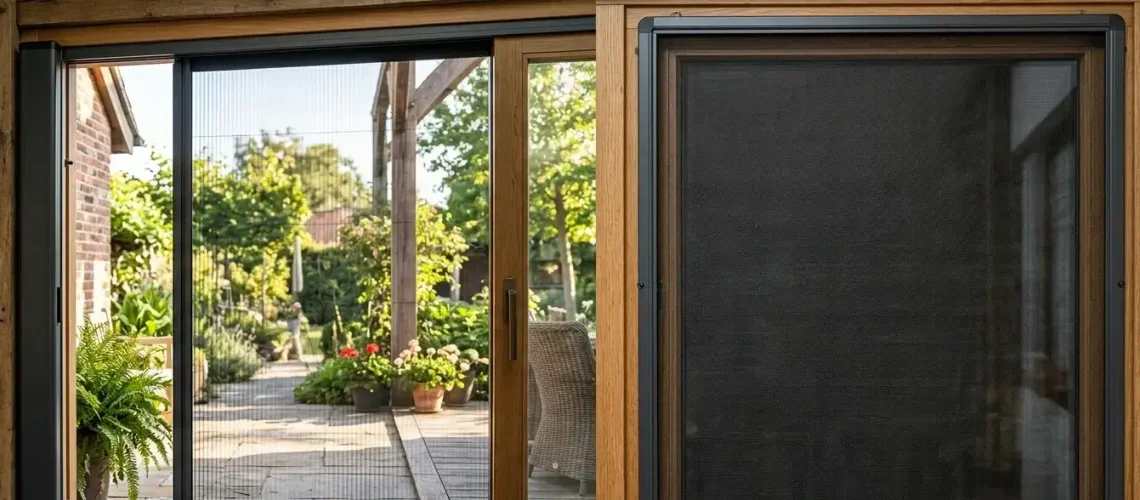
There is nothing quite like opening your windows and doors to let that fresh Canadian breeze drift through your home. It signals that winter is finally behind us or that the fresh autumn air has arrived. But as every homeowner in Toronto and the GTA knows, that fresh air often comes with unwanted guests. Mosquitoes, flies, and debris seem to view an open door as an open invitation. This brings us to a common dilemma for anyone looking to upgrade their home. You know you need screens, but which kind?
The debate of retractable screens vs fixed screens is one we encounter almost daily. It is not just about keeping bugs out. It is about how you want to interact with your home, how much you value your view, and what kind of investment you are looking to make. Are you looking for a permanent fixture that does the job without fanfare? Or are you looking for a flexible solution that disappears when you don’t need it?
In this guide, we will walk you through the differences, benefits, and potential downsides of both options. By the time you reach the end, you will have a clear picture of which solution fits your lifestyle, your budget, and your home’s aesthetic.
Key Takeaways
- Fixed screens are the traditional, budget-friendly choice that stay in place year-round but can obstruct views and accumulate dirt.
- Retractable screens offer flexibility by rolling away when not in use, preserving your sightlines and protecting the mesh from winter weather.
- Aesthetics matter: Retractable options suit modern, open-concept designs and large architectural openings, helping you maintain a seamless indoor-outdoor flow.
- Long-term value: While retractable screens have a higher upfront cost, their longevity and ability to protect the screen mesh often result in better long-term value.
- Customization: Retractable solutions are ideal for difficult openings like French doors or oversized sliding doors.
What Are Fixed Screens?
Let’s start with the option most people are familiar with. Fixed screens are the standard screens you likely grew up with. They consist of a rigid frame, usually made of aluminum, with screen mesh stretched tightly across it. Once they are installed, they are there to stay unless you physically remove them for cleaning or winter storage.
You will typically find fixed window screens on standard double-hung or casement windows. They are also the standard issue for sliding patio doors, where a secondary door frame slides along a track. They are functional, simple, and effective at their primary job: insect protection. Because they are permanently in place, they are constantly exposed to the elements, from the blazing July sun to the freezing February winds. However, their frames usually are very thin and fragile and the mesh quality is pretty low.
What Are Retractable Screens?
Now, imagine a screen that is there when you need it and gone when you don’t. That is the core philosophy behind retractable screen doors and windows. Unlike their fixed counterparts, these systems are not permanently stretched over the opening. Instead, the screen fabric rolls into a protective screen housing cassette mounted to the side or top of your door or window frame.
When you want fresh air, you simply pull the screen across or down. It glides along a track and locks into place with a magnet system. When you are done or want to enjoy an unobstructed view, the screen retracts into its housing, completely hidden from sight. They are increasingly popular for French doors, sliding doors, and even large architectural openings where a fixed frame would ruin the home’s look.
Retractable Screens vs Fixed Screens — Quick Comparison
To help you get a better grasp of how these two distinct options stack up against one another, here is a quick breakdown. This table highlights the key differences in usability, maintenance, and aesthetics.
| Feature | Fixed Screens | Retractable Screens |
| Visibility | Always visible; constantly filters the view. | Invisible when retracted; clear views when not in use. |
| Operation | Static; sliding doors can be prone to jamming. | Smooth gliding mechanism; retracts automatically. |
| Durability | Mesh is exposed to weather 365 days a year. Low-quality mesh | Mesh is stored in a housing, protected from elements. High-quality mesh |
| Maintenance | Requires removal for deep cleaning. | Self-cleaning features; easy to wipe down. |
| Upfront Cost | Lower initial investment. | Higher initial investment due to mechanics. |
| Aesthetics | Visible frames can look cluttered. | Minimalist; blends into the door frame. |
| Suitability | Standard windows and sliding doors. | Large openings, custom doors, focal points. |
Pros and Cons of Fixed Screens
To make an informed decision, you have to look at the good, the bad, and the ugly. Fixed screens have been the standard for decades for a reason, but they are not without their limitations.
Pros of Fixed Screens
The biggest advantage for most homeowners regarding fixed screens is the price tag. They are generally less expensive upfront because the technology is simple. There are no moving parts, such as springs or hydraulic dampeners, to worry about. If you have a standard-sized window in a laundry room or a basement where the view isn’t a priority, a fixed screen is a perfectly functional choice. They are readily available and relatively easy to repair if the mesh gets torn, as you can often find DIY kits at the hardware store.
Cons of Fixed Screens
The downside? They are always there. Whether it is a gloomy November day or a bright winter morning, you are looking through a grid of mesh. This can darken a room and obscure your view of the outdoors. Furthermore, because they are constantly exposed to the elements, the mesh tends to degrade faster. Sun damage can make the material brittle, and wind can gradually loosen the tension. Architecturally, they can also look a bit clunky, especially on beautiful French doors or custom entryways where you want the door’s design to shine, not the screen. Rather it’s causing an inconvenience and constant repairs; they always look jammed. If you have pets, it will constantly go off the frame.
Also Read: How Retractable Screens Can Increase Your Home’s Curb Appeal
Pros and Cons of Retractable Screens
Retractable screens are often seen as the premium upgrade, but what does that actually look like in practice? Let’s break down why people love them and what you need to consider.
Pros of Retractable Screens
The primary selling point here is visibility. When you invest in custom retractable screens, you are investing in unobstructed sightlines. When the screen is retracted, it is virtually invisible. This allows for superior natural light and an uninterrupted connection to the outdoors.
Another massive pro is protection. Because the screen rolls into the screen housing cassette when not in use, it is shielded from dirt, UV rays, and ice during the harsh Canadian winter. This significantly extends the life of the mesh. They are also incredibly versatile. Whether you have double doors, out-swinging doors, or large opening retractable screens for a bi-fold system, retractable options can be customized to fit perfectly. Even if they go off the tracks, it’s no problem, all you have to do is just slightly adjust and guide the mesh back.
Cons of Retractable Screens
Quality comes at a price. The upfront investment for a retractable system is higher than for a fixed screen. This is due to the mechanical components, the housing materials, and the need for professional installation to ensure smooth operation. Additionally, while high-quality systems are robust, cheap “big box store” versions can be flimsy. It is essential to choose a reputable manufacturer to avoid mechanical issues down the road.
Which Screen Type Is Right for Different Homeowner Needs?
One size rarely fits all in the world of home improvement. Depending on your specific situation, the winner of the retractable screens vs fixed screens debate might change. Let’s look at some common scenarios.
Best option for patios and large openings
If you have a wide expanse to cover, retractable screens are the clear winner. Fixed screens for large openings are often heavy, difficult to slide, and prone to falling off their tracks. A retractable system can span wide distances and disappear when you are entertaining, removing barriers between your kitchen and your patio.
Best option for unobstructed views
Do you have a view of the lake, a beautiful garden, or the city skyline? If so, why hide it behind mesh 24/7? Retractable screens allow you to frame that view perfectly. You only pull the screen when the bugs are biting. For the rest of the time, your glass remains clear.
Best option for seasonal use
In Canada, our “screen season” is relatively short. For the other six months of the year, we want as much light and warmth as possible. Seasonal use is where retractable screens shine. You don’t have to go through the hassle of removing and storing fixed screens in the garage every autumn. You simply let them retract into their housing, and they are safe for the winter (you can also keep them down during winter, just don’t move them when they are frozen or when there is a lot of snow).
Best option for homes with pets or kids
This is a toss-up depending on the specific product. Fixed screens can be sturdy, but if a dog jumps on them, the mesh can tear, or the frame can bend. While some retractable screens feature “braking” technology that prevents them from snapping back dangerously if a child lets go of the handle, ROLLerUP screens are not spring-loaded, so whenever the screen is released, it will stop, with no snapping concerns. However, because retractable screens are sometimes harder to see, pets might accidentally run into them. If that happens, it’s easy to guid them back into the system.
Best option for budget-focused projects
If you are renovating a rental property or simply need to get code-compliant screens on standard windows to sell a house, fixed screens are the logical choice. They get the job done with minimal expense.
Cost Comparison — Upfront Price vs Long-Term Value
We need to talk about money. It is the factor that often drives the final decision.
When evaluating the pros and cons of fixed screens, the low entry price is the main “pro.” However, you have to consider the “penny-wise, pound-foolish” idiom here. Fixed screens often need re-screening every few years due to weather exposure. The frames can oxidize or bend, and the plastic wheels on sliding versions break frequently.
The pros and cons of retractable screens include a higher initial cost. You are paying for engineering, aluminum housing, and a specialized magnetic mechanism. However, because the mesh is protected for half the year inside the housing, it can last significantly longer than exposed mesh. When you factor in the lifespan and the fact that you won’t need to replace rollers every 2 years, the long-term value of a retractable system becomes much clearer.
Maintenance, Durability, and Lifespan
How much work do you want to do? That is the real question here.
Fixed screens are dirt magnets. They sit there collecting pollen, dust, and street grime all day, every day. Cleaning them usually involves popping them out of the window frame (a struggle in itself), taking them into the yard, scrubbing them with soapy water, and hoping you don’t bend the frame while wrestling them back in. They are also constantly going out of the tracks, making them a constant hassle.
Retractable screens, on the other hand, require much less fuss. The housing acts as a shield. Furthermore, many high-end systems have internal brushes inside the canister. Every time you retract the screen, these brushes gently wipe debris off the mesh. Maintenance usually involves nothing more than wiping down the tracks to keep the gliding smooth.
Regarding lifespan, a fixed screen left out in a Toronto winter might survive, but it won’t thrive. Ice can expand in the frame corners, causing separation. Retractable screens avoid this battle entirely by hibernating in their protective shell. Moisture can also cause mould inside the fixed screen frame.
Design & Aesthetic Impact on Your Home
Your home is likely your biggest asset, so appearances matter. The trend in modern architecture and renovation is indoor–outdoor living. We are seeing more walls of glass, wider doors, and cleaner lines.
Fixed screens can feel like visual clutter in these spaces. They add extra vertical lines and a permanent grey haze over your glass. They essentially scream, “I am a screen!”
Retractable screens are designed to be subtle. The housing can be colour-matched to your door frame, making it look like a native part of the architecture rather than an afterthought. When you are hosting a dinner party and the doors are open, the screens can be hidden away, creating a sophisticated, open atmosphere. It preserves your home’s architectural integrity while providing patio screen solutions when needed.
When Fixed Screens Still Make Sense
We are obviously big fans of retractable solutions, but we are also realists. There are times when a fixed screen is the right tool for the job.
If you have windows you keep open for ventilation 24/7 during the summer, such as a bathroom or second-story bedroom window, a fixed screen makes perfect sense. You aren’t likely to walk through these openings, and you might not care as much about the view from a bathroom.
Additionally, for very small windows, the housing mechanism of a retractable screen might take up too much space relative to the glass size. In these instances, the slim profile of a fixed frame is advantageous.
Also Read: Maintenance Tips for Your Retractable Screen System
Why More Homeowners Are Choosing Retractable Screens
We have noticed a distinct shift in the market over the last few years. More Canadians are moving away from standard builder-grade options and seeking custom sizing and premium features. Why is this happening?
It largely comes down to the changing way we live. Homes are becoming smaller or more multi-functional. We want our living rooms to extend onto the balcony or deck. Sliding doors and French doors are being used more frequently to create these connections. Homeowners are realizing that fixed screens limit this flow.
There is also a growing appreciation for minimalism. People want products that work beautifully but don’t demand attention. A screen that disappears fits this ethos perfectly. It is there to serve a purpose, blocking bugs, and then it politely leaves the room.
Frequently Asked Questions
Are retractable screens worth the cost?
For most homeowners who value aesthetics and longevity, the answer is yes. The ability to hide the screen protects your view and the mesh itself, offering better value over time than repeatedly replacing fixed screens.
Do retractable screens last as long as fixed screens?
Often, they last longer. Because the mesh is stored away from UV rays, wind, and ice when not in use, the material degrades much slower than a fixed screen that is permanently exposed. The retractable screen frame is built right within the door casing/frame, so the only part that moves is the mesh/screen. It has minimal mechanical parts compared to the fixed screen that moves with the frame on a bottom rail on small wheels that need constant cleaning and greasing to keep the operation smooth.
Can retractable screens be used for large openings?
Absolutely. This is their specialty. Large opening retractable screens can span wide distances that fixed screens simply cannot handle without becoming unwieldy.
Which screen type is better for Canadian weather?
Retractable screens have the edge here because they can be stored away during snowstorms and freezing rain without taking up garage space.
Do retractable screens require more maintenance?
They require different maintenance, but generally less scrubbing. Keeping the tracks free of dirt is the main requirement, whereas fixed screens need full washing to remove trapped grime.
Finding the Perfect View for Your Home
Choosing between retractable screens vs fixed screens ultimately comes down to how you want to experience your home. If you are looking for a strictly utilitarian, low-cost solution for a basement window, the fixed screen remains a trusty option. However, if you want to boost your living space, protect your investment from the harsh seasons, and enjoy unobstructed views of our beautiful outdoors, the retractable screen is the modern standard.
Why compromise your view for bug protection when you can have both? At ROLLerUP, we specialize in helping you find the perfect balance between function and design. Whether you have a tricky doorway or a grand patio opening, we have the expertise to fit it perfectly.
Would you like to see how a custom retractable screen would look on your door? Reach out to us today for a free consultation and quote.