
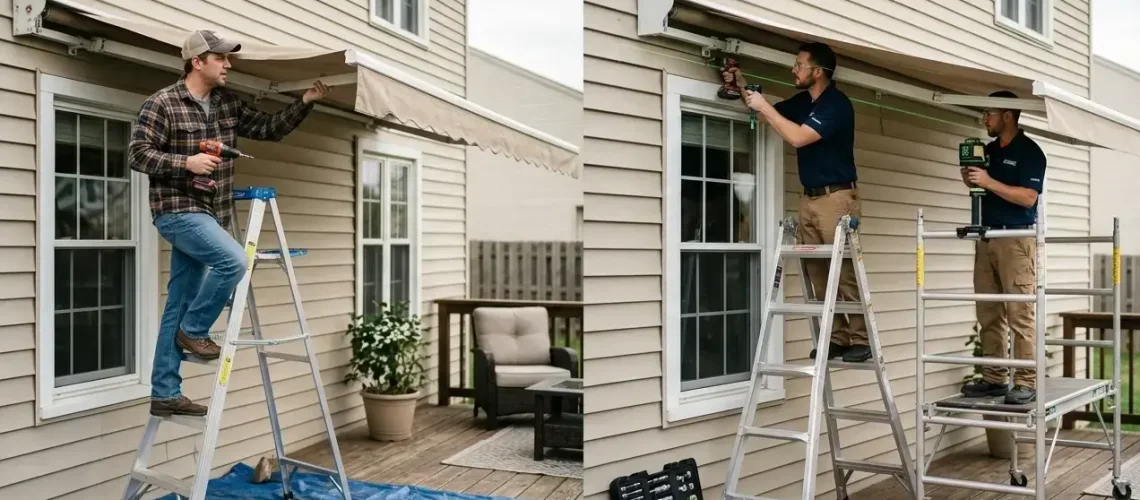
There is a special kind of pride that comes with completing a home improvement project on your own. We completely understand the temptation to grab your toolbox, rally a willing neighbour, and tackle the job over the weekend. If you are currently weighing DIY vs professional awning installation, you are definitely in good company. Many homeowners in Toronto and across Canada want to enhance their outdoor living spaces while keeping an eye on the budget.
However, before you break out the drill, it is important to understand that putting up a shade structure is rarely a simple walk in the park. The complexity of the job depends heavily on the specific type of unit you choose. A small window shade requires a vastly different approach compared to a heavy, motorized patio canopy. You have to navigate strict structural requirements and intricate electrical connections.
At ROLLerUP, we have seen it all. We have installed countless systems perfectly on the first try, and we have also rescued quite a few well-intentioned do-it-yourself attempts that went sideways. Our goal is to give you the honest, practical facts so you can make the safest and smartest decision for your property.
Key Takeaways
- Weight is the enemy of guesswork: Large units exert massive force on exterior walls and must be anchored to structural framing, never just to the siding.
- Warranties demand perfection: Manufacturer guarantees often become void if the unit is installed incorrectly or without proper documentation.
- Electrical work has strict rules: Motorized units exposed to the elements require specific safety measures and outdoor-rated connections.
- Canadian weather is unforgiving: Local wind and snow conditions dictate structural requirements that DIY kits sometimes overlook.
- The How and Where Matter: The location and type determine the right size and dimensions.
Quick Comparison Table
When deciding how to proceed, a clear side-by-side look can help clear the fog. Here is a quick breakdown of how doing it yourself stacks up against hiring the pros.
| Feature | DIY Installation | Professional Installation |
| Upfront Cost | Lower (materials and your own time). You might incur cost for buying or renting additional tools and equipment. | Higher (includes expert labour and guarantees). |
| Time Investment | A full weekend or more (plus supply runs). | Usually completed in just a few hours. |
| Warranty Risk | High risk of voiding the manufacturer warranty. | Warranty remains fully protected and documented. |
| Safety & Structural Risk | High (you assume all liability for property damage). | Low (the installer handles load calculations and liability). |
| Best Suited For | Small, lightweight, manual units on single-story wood framing. | Heavy, motorized units, brick/stucco walls, or high elevations. |
What Makes Awning Installation Challenging?
Have you ever tried holding up a hundred pounds of awkward metal while balancing on a wobbly ladder? It is a recipe for disaster. The installation process involves far more than simply driving a few screws into a wall.
Weight and Structural Load
Larger structures are deceptively heavy. But the static weight is only half the story. When the canopy is fully extended, it acts like a giant sail. The leverage exerted on the mounting brackets is immense. To keep the unit securely attached to your house, the brackets must be anchored directly into the structural framing. Fastening a heavy piece of hardware strictly to the exterior siding is practically begging for a structural failure. If the wind catches it, a poorly secured unit can literally tear the side off your house. A faulty installation can also lead to your insurance declining potential claims.
Mounting Surface Matters
The material on the outside of your home dictates exactly how the job must be done. Standard wood framing is relatively straightforward if you know how to find the exact centre of a stud. However, mounting an awning to brick or stucco introduces serious complications. Brick requires specialized masonry anchors and precise drilling to avoid cracking the mortar. Stucco and Exterior Insulation and Finish Systems (EIFS) are highly susceptible to moisture damage if the mounting points are not perfectly sealed. Even vinyl siding poses a challenge, as compressing it with heavy brackets can warp the plastic.
Height & Access
Putting a small canopy over a ground-floor window is one thing. Trying to hoist a massive patio cover onto a second-story balcony is a completely different beast. Working at heights introduces severe fall risks. Handling power tools, heavy materials, and levelling equipment while standing on scaffolding or ladders requires experience and strict safety procedures.
Also Read: Why Awnings Are a Must-Have This Summer
DIY Installation: When It Can Make Sense
Are we saying you should never attempt this yourself? Not necessarily. There are specific situations in which you can successfully install an awning yourself without inviting disaster.
Best Scenarios:
- You purchased a small, lightweight manual shade.
- You are installing it on a single-story wall with easy ground access.
- You have confirmed solid wood framing behind the exterior.
- Your home uses basic exterior materials, such as simple wood cladding.
Requirements for Success:
- A high-quality stud finder that you know how to read perfectly.
- Heavy-duty lag bolts designed for exterior structural loads.
- A sturdy ledger board to distribute weight evenly.
- Premium, exterior-grade weatherproof sealants to prevent rot.
The Underlying Risks:
Even in the best-case scenarios, DIYers face major obstacles. An incorrect pitch can cause rain to pool in the fabric, eventually stretching or snapping the arms. Improper sealing will lead to water intrusion, which silently rots your wall framing over the years. The most frightening risk remains pull-out failure, where misaligned anchors strip out of the wood under tension.
Professional Installation: What You’re Paying For
When you hire a professional awning installation team, you are not just paying for manual labour. You are investing in peace of mind, technical expertise, and long-term security.
Structural Assessment
Experts do not guess where the studs are. They perform a thorough evaluation of your mounting surface. They calculate the precise load distribution required for the specific size of your canopy and ensure the bracket placement will withstand severe weather. They know exactly how to handle tricky facades without compromising the integrity of your home.
Code & Permit Awareness
Did you know that local municipalities have strict rules about exterior structures? Depending on the size of the unit and the footprint of your property, you might face strict regulations. Navigating an awning permit in Canada requires an understanding of zoning bylaws, property lines, and structural requirements. Professionals handle this paperwork regularly and ensure your project remains completely above board. In most residential cases, retractable awnings will not require a building permit because they are considered a temporary or non-structural addition. However, if you have a very large awning that is permanently attached, installed on a condo or located in a heritage district, you might still need a permit. Always verify with your local municipality, as regulations differ, especially for commercial properties.
Electrical Safety (Motorized Awnings)
Water and electricity are notorious enemies. When dealing with powered units, adhering to outdoor GFCI outlet requirements is non-negotiable. Professionals coordinate with licensed electricians to ensure that all wiring is safely hidden, correctly grounded, and fully protected from the harsh Canadian elements. They also calibrate the wind and sun sensors to ensure the motor operates flawlessly.
Warranty Protection
This is the elephant in the room. Most premium manufacturers include a clause stating that the warranty is only valid if the unit is installed by a certified professional. If a DIY installation results in a bent arm or a burnt-out motor, the manufacturer will likely deny your claim. Paying for a professional installer shields you from liability and protects your investment.
Motorized & Retractable Awnings: Why They’re Different
You might think that adding a motor to a canopy just means plugging it in. In reality, motorized awning systems are sophisticated pieces of machinery.
Electrical Components
The difference between a hardwired system and a basic plug-in unit is vast. Hardwired setups require routing cables safely through exterior walls while maintaining a watertight envelope. Furthermore, modern setups come with remote controls, smart home integrations, and automated weather sensors. Programming these delicate electronics requires specialized training.
Moving Parts
Manual systems are fairly basic (but might struggle if not properly installed), but motorized units rely on perfectly balanced arm tension and exact motor alignment. If the pitch is even slightly miscalibrated, the motor has to work twice as hard to retract the fabric. Over time, this extra strain will burn the motor out prematurely. Because of these complex mechanical and electrical demands, professional installation is strongly recommended for almost all motorized setups.
Canada-Specific Considerations
We live in a beautiful country, but our weather can be absolutely brutal. Installing exterior fixtures here requires a deep understanding of the local climate.
Snow & Wind Loads
You cannot ignore an awning snow load Canada rating. Even though you should retract your canopy when not in use, the housing unit itself must withstand heavy ice buildup and freezing rain. Furthermore, sudden summer thunderstorms in places like Toronto bring violent wind gusts. Professionals ensure that the load ratings of both the hardware and the mounting anchors exceed the demands of our harsh climate realities as rain and wind are the biggest enemies of your awning.
Permits
Bylaws vary wildly from one municipality to the next. What is perfectly legal in a rural backyard might require extensive paperwork in a dense urban centre. It is important to verify local regulations before drilling a single hole. As mentioned above, in most residential cases, retractable awnings will not require a building permit, but very large awnings, permanently attached, installed on a condo or located in a heritage district, might trigger a permit. Always verify with your local municipality, as regulations differ, especially for commercial properties.
Exterior Wall Construction Differences
Canadian homes are built to keep the cold out, which creates unique exterior wall complexities. Thick brick veneer looks sturdy but offers zero structural support for heavy cantilevered loads. Insulated siding systems and deep EIFS foam layers mean the actual structural wood might be several inches away from the exterior surface. Bridging that gap safely requires long, specialized anchors and expert compression management.
Cost Comparison: DIY vs Professional
It is easy to look at an awning installation cost in Canada quote and think you can save a fortune by doing it yourself. However, a true cost comparison requires looking past the initial price tag.
DIY Costs
- The retail price of the awning kit.
- Purchasing or renting specialized tools (hammer drills, heavy-duty ladders, scaffolding).
- Buying premium masonry anchors, ledger boards, and industrial sealants.
- Hiring an electrician separately if your unit is motorized.
- The massive investment of your personal weekend time.
- Potential future repair costs if water intrusion or structural failure occurs.
- Many DIYers also underestimate the trips to the store to get additional tools or hardware during the process.
- If the awning is big, you might also need to rent a truck or van or pay additionally for delivery.
Professional Costs
- Expert installation labour.
- A comprehensive structural assessment.
- Full manufacturer warranty protection.
- Seamless electrical coordination.
- Precise motor calibration and structural testing.
When you factor in the tool rentals, the physical risk, and the danger of property damage, the long-term value of a professional installation heavily outweighs the short-term savings of a DIY attempt.
Decision Framework: Which Option Is Right for You?
Still on the fence? Let us break down the decision into a simple framework to help you choose the best path forward.
Choose DIY If:
- You are installing a small, manual awning.
- You are highly experienced and comfortable with structural wall mounting.
- There is absolutely no electrical work required.
- You are working on a safe, single-story installation with easy access.
Choose Professional If:
- You are investing in a large or motorized unit.
- Your home has a brick, stone, or stucco exterior surface.
- The unit must be mounted on a second story or above a tricky landscape feature.
- You have any uncertainty regarding permits, structural loads, or finding wall studs.
Also Read: Awning Costs in Canada 2026: Retractable vs Fixed vs Motorized
Common DIY Mistakes to Avoid
If you do decide to take the plunge yourself, please keep an eye out for these classic blunders. We fix these specific issues on a weekly basis.
- Mounting into siding only: Screwing brackets into vinyl or aluminum siding without hitting the wooden studs guarantees the unit will rip off the wall during the first strong wind.
- Ignoring pitch requirements: Failing to angle the canopy correctly allows rainwater to pool in the centre of the fabric, leading to massive water weight that destroys the arms.
- Skipping weatherproof sealing: Forgetting to fill the drill holes with premium exterior silicone invites rainwater directly into the framing of your house, causing invisible, expensive rot.
- Using incorrect anchors: Using standard drywall screws or cheap plastic masonry plugs instead of structural lag bolts is a recipe for disaster.
- Not checking warranty conditions: Opening the box and throwing away the manual often voids the manufacturer’s guarantee before you even mount the first bracket.
FAQ
Can I install a retractable awning myself?
Yes, you can attempt a retractable awning installation yourself if it is a small, manual unit and you possess advanced carpentry skills. You will need a strong helper, heavy-duty tools, and a deep understanding of your home’s structural framing. However, for heavy units, second-story mounts, or homes with brick exteriors, attempting the job yourself carries a significant risk of property damage or personal injury.
Does DIY awning installation void the warranty?
In many cases, yes. Most premium manufacturers explicitly state that their warranties are only valid if the product is installed by a certified professional. If you install it yourself and damage the motor, bend the arms due to improper levelling, or experience a structural failure, the manufacturer will likely reject your claim. Always read the specific warranty conditions before opening the box.
Do I need a permit for an awning in Canada?
It depends entirely on your local municipality and the size of the structure. Many cities across Canada require a building permit for structures that exceed a certain square footage, project a specific distance from the home, or feature permanent structural supports, so for most awnings, a permit will not be required. It is critical to consult your local building department before beginning any work to avoid fines or forced removal.
Does a motorized awning require a GFCI outlet?
Absolutely. Any electrical device installed on the exterior of a home must be plugged into or hardwired to an outlet equipped with a Ground Fault Circuit Interrupter (GFCI). This is a vital safety requirement designed to cut power instantly if moisture enters the system. Failing to use a GFCI outlet creates a severe risk of electric shock and violates local electrical codes.
How long does professional awning installation take?
For a trained crew, a standard motorized awning installation typically takes between two and four hours from start to finish. This timeframe includes the structural assessment, securing the mounting brackets, hoisting the unit, completing the electrical connections, and fully calibrating the motor and sensors.Complex custom installations or tricky exterior surfaces may slightly extend the timeline..
Is professional installation worth the cost?
Without a doubt. Hiring a professional awning installer provides peace of mind, guarantees your safety, and protects your property from severe structural damage. Professionals ensure the unit is safely anchored against high winds, correctly sealed against water intrusion, and perfectly calibrated. Factoring in the protection of your manufacturer’s warranty, the upfront cost is a very smart long-term investment.
Securing Your Shade: The Final Verdict on Awning Installation
At the end of the day, upgrading your patio should bring you relaxation, not stress. While the DIY route might seem like a fun weekend challenge, the risks associated with structural loads, complex exterior siding, and tricky electrical components are substantial. Protecting your home from water damage and ensuring your new shade structure stays firmly attached to the wall requires a level of precision that goes far beyond basic handiwork. By choosing an expert team, you safeguard your warranty, ensure local code compliance, and guarantee that your outdoor oasis will withstand the demanding Canadian climate for years to come.
Would you like to connect with one of our ROLLerUP specialists for a free, no-obligation structural assessment of your home today?